Ex-Search TI Optimization Pipeline
The Ex-Search module provides a high-performance, exhaustive search approach for Temporal Interference (TI) simulations. The public API is run_ex_search(config: ExConfig) -> ExResult.
Overview
Ex-Search implements a true exhaustive search approach for Temporal Interference (TI) optimization, systematically evaluating all possible electrode combinations within user-defined constraints. Unlike sampling-based methods, ex-search guarantees finding the globally optimal montage configuration.
The implementation uses a single ExSearchEngine class that owns the full pipeline: leadfield loading, ROI resolution, TI field computation, and the simulation loop.
Key Features:
- True Exhaustive Search: Evaluates all electrode combinations x current ratios
- Multiple EEG Nets: Support for high-density (10:10) and 10-20 nets with automatic co-registration
- ROI Analysis: Spherical ROI definition with configurable radius specification (default 3mm)
- Current Ratio Optimization: Systematic testing of current ratios respecting channel limits
- High-Performance Processing: Memory-efficient in-memory calculations with real-time progress tracking
- Comprehensive Metrics: TImax, TImean, Focality analysis with automatic visualization
- Proper Error Handling: Custom exceptions instead of SystemExit for better integration
Search Modes
Ex-Search supports two electrode assignment strategies:
Bucketed Mode (Original)
Electrodes are pre-assigned to specific channels:
- E1+: Electrodes for positive channel 1
- E1-: Electrodes for negative channel 1
- E2+: Electrodes for positive channel 2
- E2-: Electrodes for negative channel 2
Combinations: N₁ × N₂ × N₃ × N₄ (where N = electrodes per bucket)
Pooled Mode (New)
All electrodes are pooled together and can be assigned to any channel position, with the constraint that each electrode is used only once per montage.
Combinations: C(N,4) × 4! (where N = total electrodes, C = combinations)
Trade-off: Larger search space and longer compute time but with absolute certainty to find optimal solution with given electrode space.
User Interface
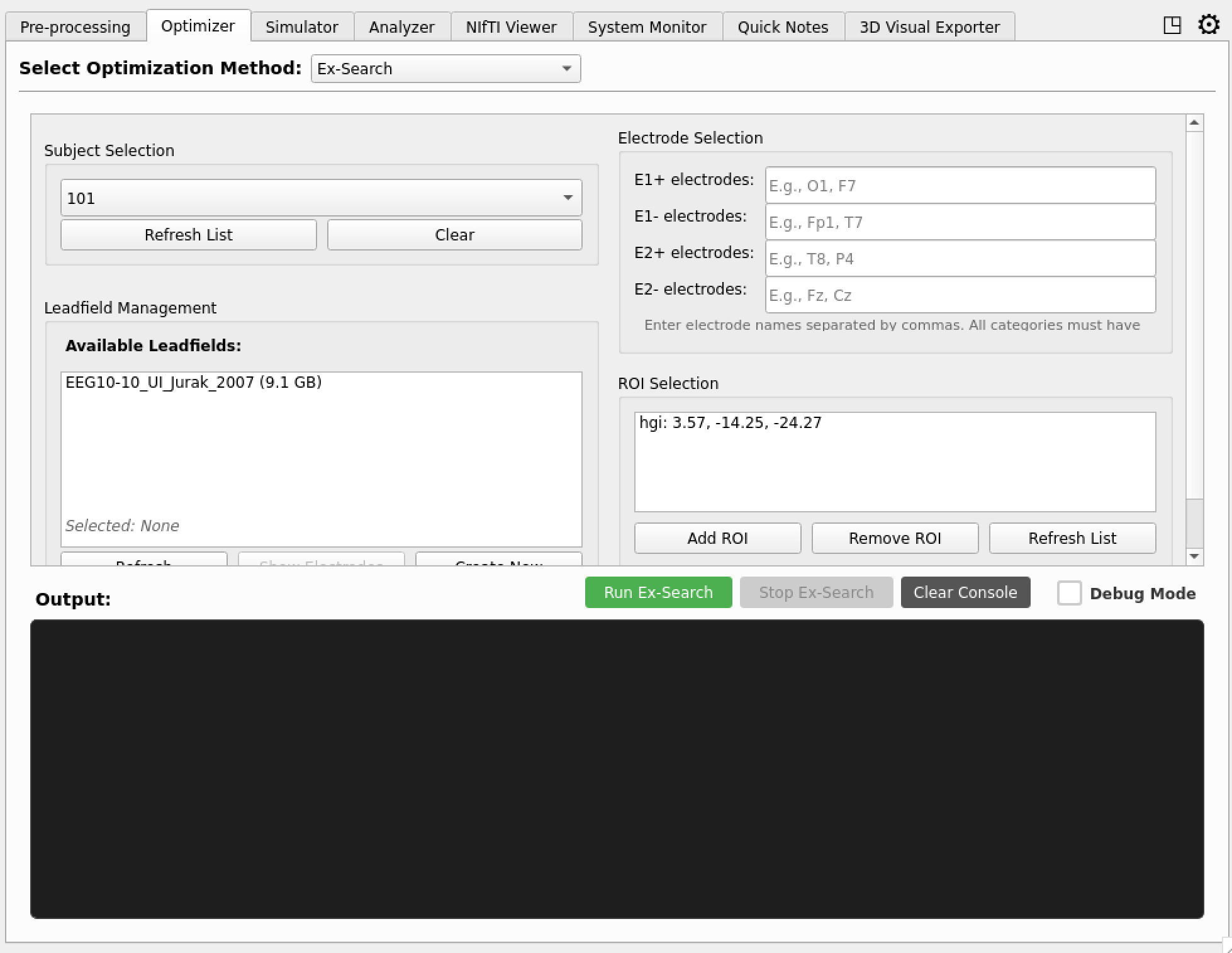
The interface provides controls for:
- Subject Selection: Choose from available subjects with automatic leadfield scanning
- Leadfield Management: View existing leadfields, create new ones, and show electrode configurations
- ROI Configuration: Add target regions with coordinates and manage multiple ROIs
- Electrode Setup: Configure E1+, E1-, E2+, E2- with support for both GSN and 10-20 formats
- Execution Control: Run optimization with real-time progress tracking
Supported EEG Nets
Ex-Search automatically detects and supports multiple EEG electrode configurations:
(EEG nets autoamtically co-registered during pre-processing)
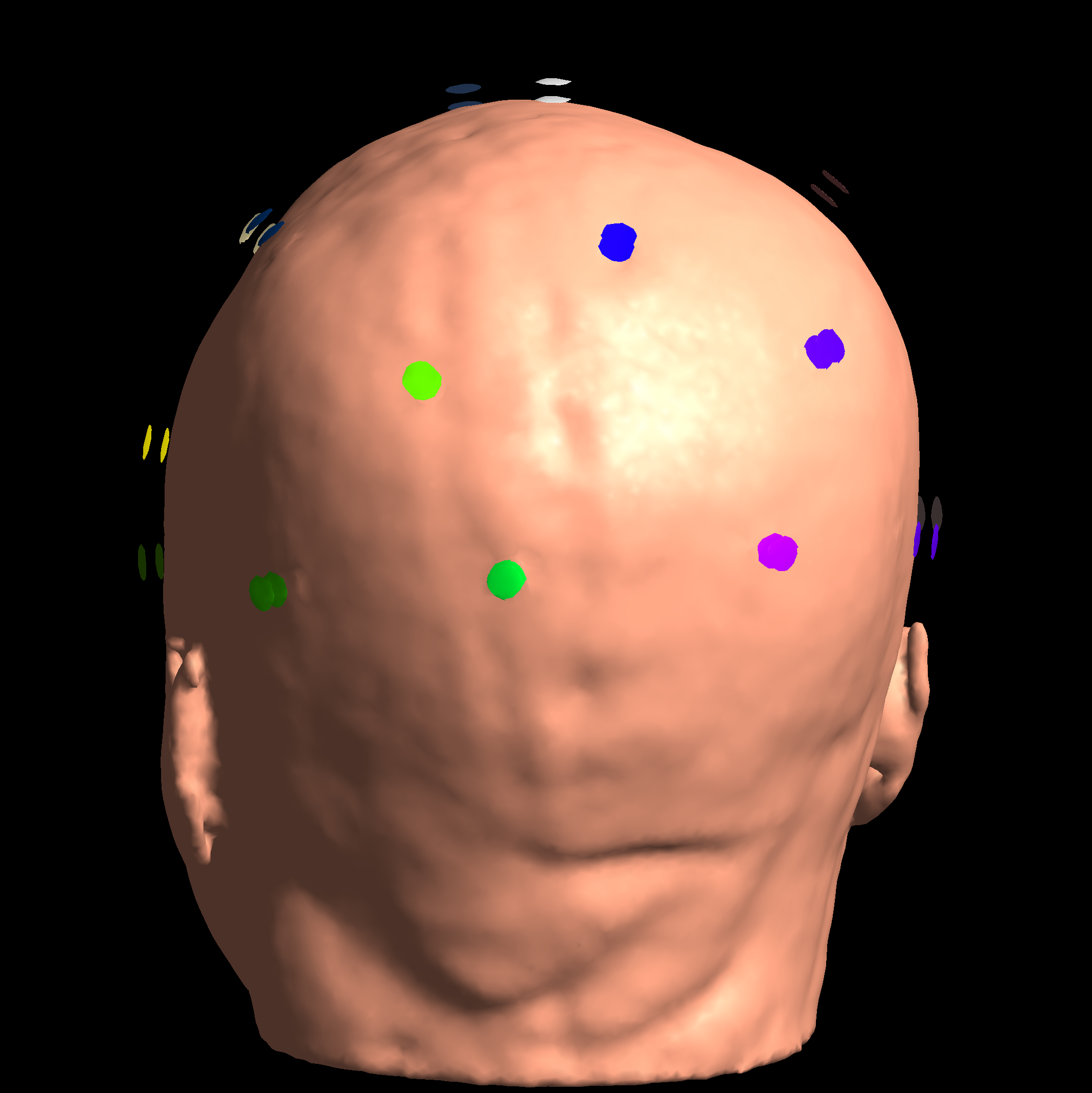 EGI 10-20 Okamoto 2004 electrode configuration - widely used standard with 32 electrodes
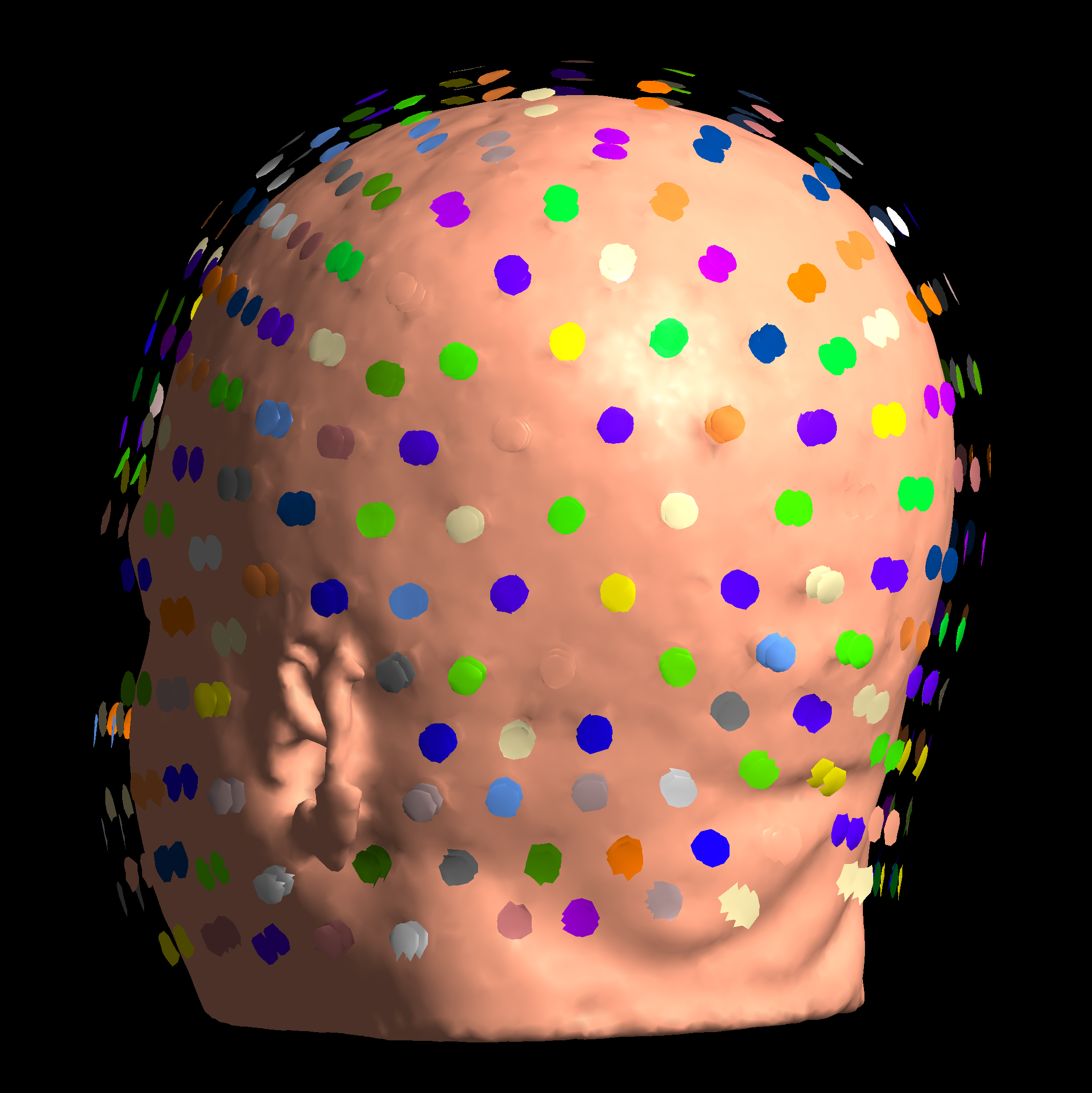 GSN-HydroCel 256 electrode configuration - high-density net for precise targeting
Example Results:
| Montage | TImax_ROI | TImean_ROI | TImean_GM | Focality |
|---|---|---|---|---|
| Fp1_Pz <> C3_C4 | 0.1748 | 0.1418 | 0.1595 | 0.8892 |
| Fp1_Pz <> C3_F4 | 0.2321 | 0.1480 | 0.1723 | 0.8587 |
| Fp1_Pz <> C3_P4 | 0.1632 | 0.1150 | 0.1637 | 0.7025 |
| Fp1_Pz <> F3_C4 | 0.1884 | 0.1558 | 0.1803 | 0.8643 |
Pipeline Workflow
1. EEG Net Selection
[INFO] Scanning available EEG nets for subject 101...
  1. EGI10-10_Cutini_2011.csv
  2. EGI10-10_UI_Jurak_2007.csv
  3. EGI10-20_Okamoto_2004.csv
  4. GSN-HydroCel-185.csv        # Default selection
  5. GSN-HydroCel-256.csv
  6. easycap_BC_TMS64_X21.csv
2. Leadfield Management
- Intelligent Detection: Automatic scanning of existing leadfields with HDF5 validation
- Flexible Creation: Generate leadfields for any supported EEG net with automated naming
- Performance Optimization: Efficient loading of large matrices (2-20GB) with memory monitoring
3. Current Ratio Optimization
The optimization systematically tests current ratios respecting channel limits:
For total_current=2.0mA, step=0.2mA, limit=1.6mA:
  (1.6, 0.4), (1.4, 0.6), (1.2, 0.8), (1.0, 1.0),
  (0.8, 1.2), (0.6, 1.4), (0.4, 1.6)
4. Exhaustive Search Algorithm
- Electrode Combinations: N⁴ combinations where N is electrodes per channel group
- Current Ratios: Systematic testing across user-defined current steps
- Total Combinations:
electrode_combinations × current_ratios - In-Memory Processing: No intermediate mesh files, direct field extraction
- Progress Tracking: Real-time monitoring with ETA calculations
5. Analysis & Visualization Pipeline
- Run Time: From minutes to hours depending on leadfield size and electrode combinations
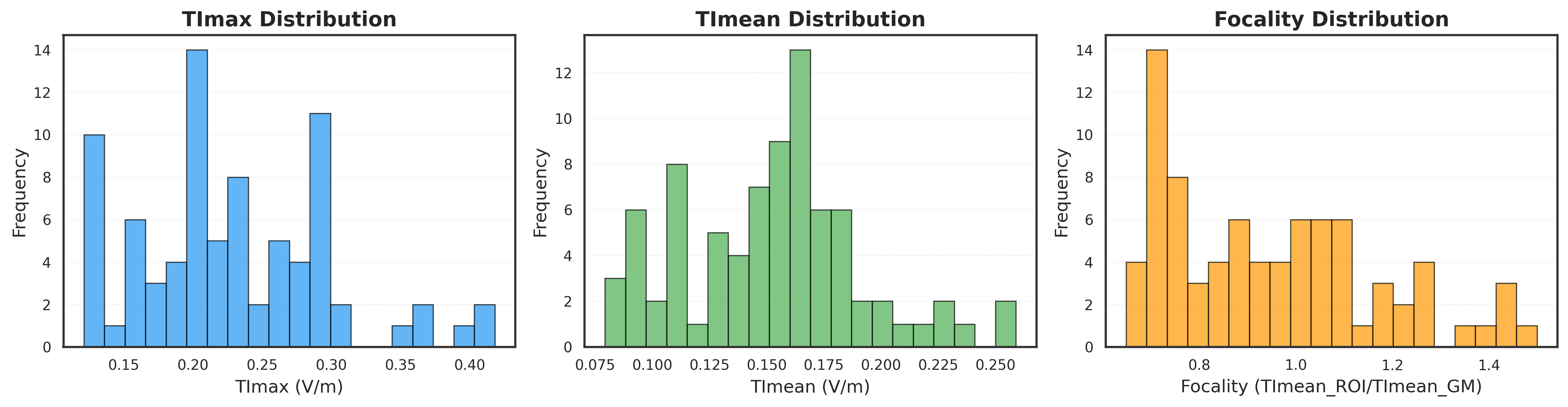
- Metrics Calculation: TImax_ROI, TImean_ROI, TImean_GM, Focality (TImean_ROI/TImean_GM)
- Visualization: Automatic histogram generation (TImax, TImean, Focality distributions)
- Output Formats: JSON results, CSV summaries, PNG histograms
Technical Implementation
Architecture
The ex-search engine is built around a single ExSearchEngine class that consolidates what was previously split across multiple classes (LeadfieldAlgorithms, LeadfieldProcessor, TIAlgorithms, TISimulator). This class owns the full pipeline:
- Leadfield loading via SimNIBS
TI_utils - ROI resolution from CSV coordinates + sphere radius
- GM element identification by tissue tag
- TI field computation per montage combination
- Metric extraction (TImax, TImean, Focality)
Performance Characteristics
- Scalability: Handles large electrode combinations (1000+ montages) efficiently
- Memory Usage: Constant memory footprint regardless of combination count – all computation is in-memory with no intermediate file I/O
- Progress Tracking: Real-time ETA calculation with rate monitoring
- Graceful Interruption: Signal handling (SIGINT/SIGTERM) for clean shutdown