Troubleshooting
Docker Issues
Docker not running
Symptoms: “Docker daemon not running” or “Cannot connect to Docker”
Solution:
- Windows/macOS: Start Docker Desktop and wait for green status
- Linux:
sudo systemctl start docker
sudo systemctl enable docker
Insufficient resources
Symptoms: Slow performance, out of memory errors, failed simulations
Solution:
- Open Docker Desktop settings -> Go to Resources
- Allocate: Memory: 32GB minimum
- Apply and restart Docker
Docker images not downloading
Symptoms: Stuck at “Pulling image” or network timeouts
Solution:
- Check internet connection
- Restart Docker Desktop
- Try manual pull:
docker pull idossha/simnibs:{version}
New version image pulling
Every time a new version of TI-Toolbox is released, the updated Docker image needs to be pulled from Docker Hub. This is a normal process that occurs automatically when you first run a new version.
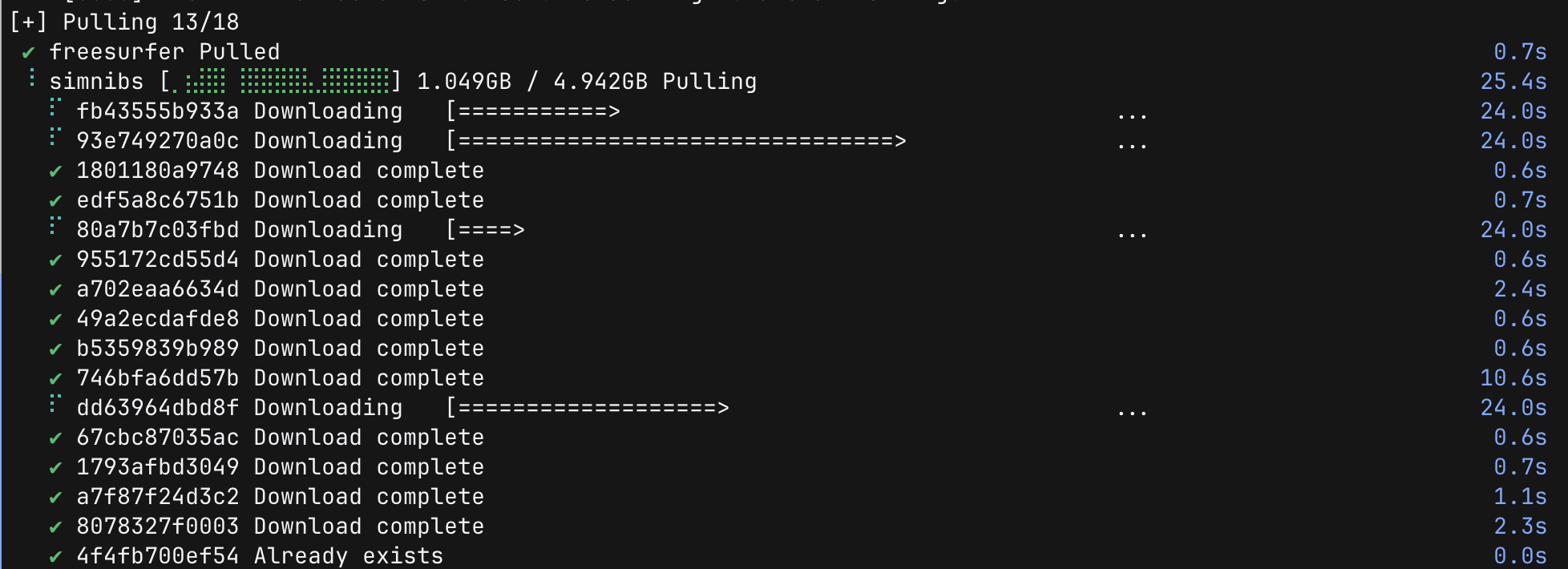 Figure: Docker Desktop showing the image pulling process for a new TI-Toolbox version
What happens:
- Docker downloads the latest container image from Docker Hub
- This may take several minutes depending on your internet connection speed
- Progress is shown in Docker Desktop or the application logs
- The image size is typically 5-10GB depending on the version
Subsequent runs:
- Once downloaded, the image is cached locally
- Future runs of the same version will start much faster
- You only need to download each version once
To manually pull the latest image:
docker pull idossha/simnibs:latest
If the download seems slow:
- Check your internet connection speed
- Use a wired connection if possible
- Try during off-peak hours
- Ensure you have at least 20GB of free disk space
GUI Display Issues
No GUI appears (Linux)
Solution:
# Allow Docker to access X11
xhost +local:docker

# Check DISPLAY variable
echo $DISPLAY

# If empty, set manually
export DISPLAY=:0
No GUI appears (macOS)
Solution:
- Ensure [XQuartz 2.7.7] is installed (not newer versions)
- Log out and back in after XQuartz installation
- Launch XQuartz from Applications > Utilities
- Check XQuartz preferences: Allow connections from network clients
If still running into issues, download the config_sys.sh place it next to your loader.sh, and run it:
bash config_sys.sh
No GUI appears (Windows)
Solution:
- Ensure VcXsrv is running (check system tray)
- Verify VcXsrv configuration:
- Multiple windows
- Start no client
- “Disable access control” MUST be checked
- Restart VcXsrv if needed
- Check Windows Firewall isn’t blocking VcXsrv
Getting Help
Information to Include
When reporting issues, include:
- System Information:
- OS version
- Docker version
- Available RAM/storage
- X server version (XQuartz/VcXsrv)
- Error Details:
- Exact error messages
- Steps to reproduce
- When the error occurs
- Screenshot if applicable
- Log Files:
- Docker logs:
docker logs [container_name] - Application logs from output directory
- System logs if relevant
- Docker logs:
Where to Get Help
- GitHub Issues - Search existing issues first
- GitHub Discussions - Community support
- Documentation - Check other installation guides for platform-specific help
Diagnostic Commands
Run these commands to gather system information:
# System information
uname -a
docker --version
docker info

# Docker status
docker ps
docker images

# Display information
echo $DISPLAY
xhost  # Linux/macOS only

# Resource usage
free -h  # Linux
top      # All platforms